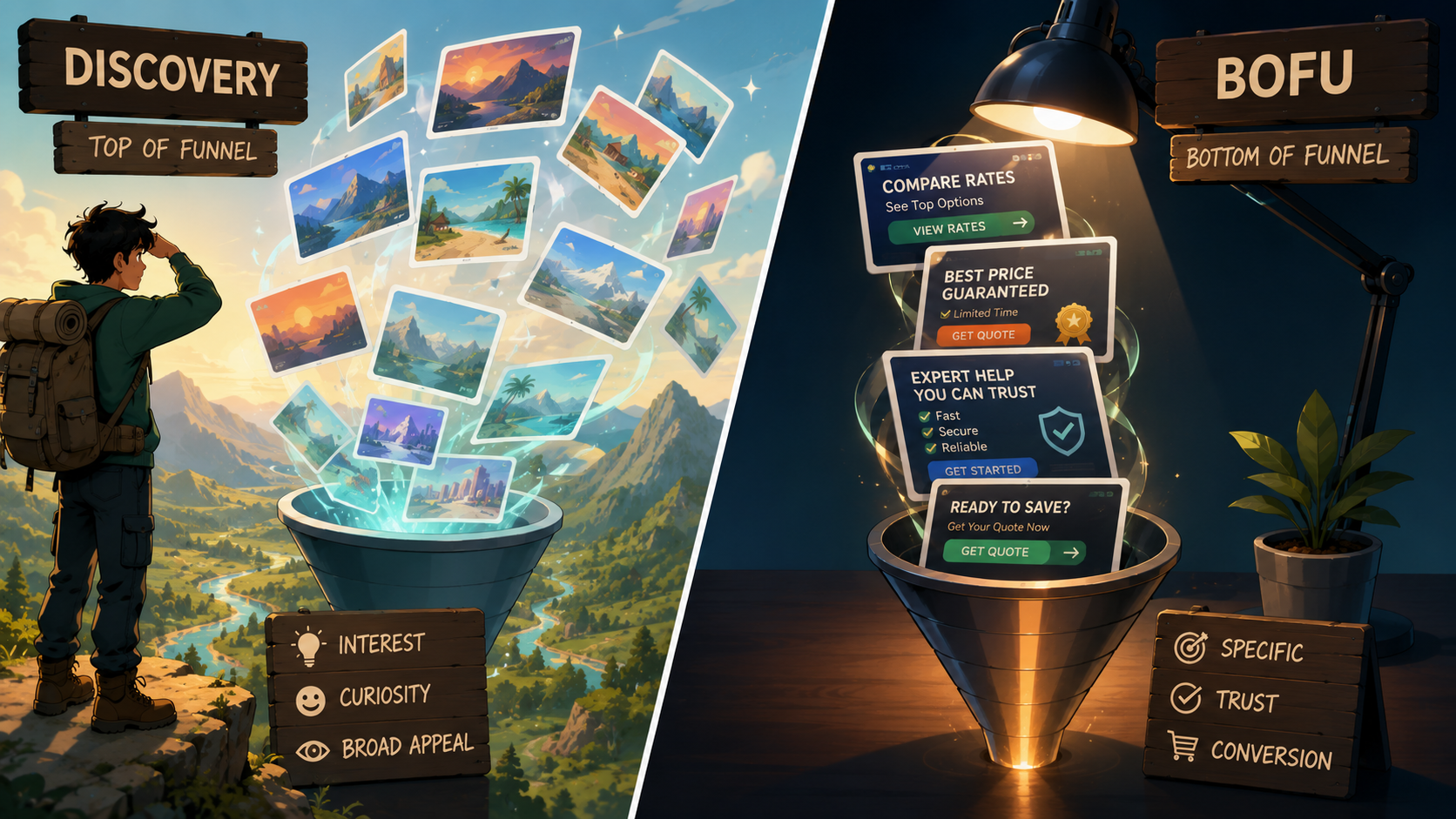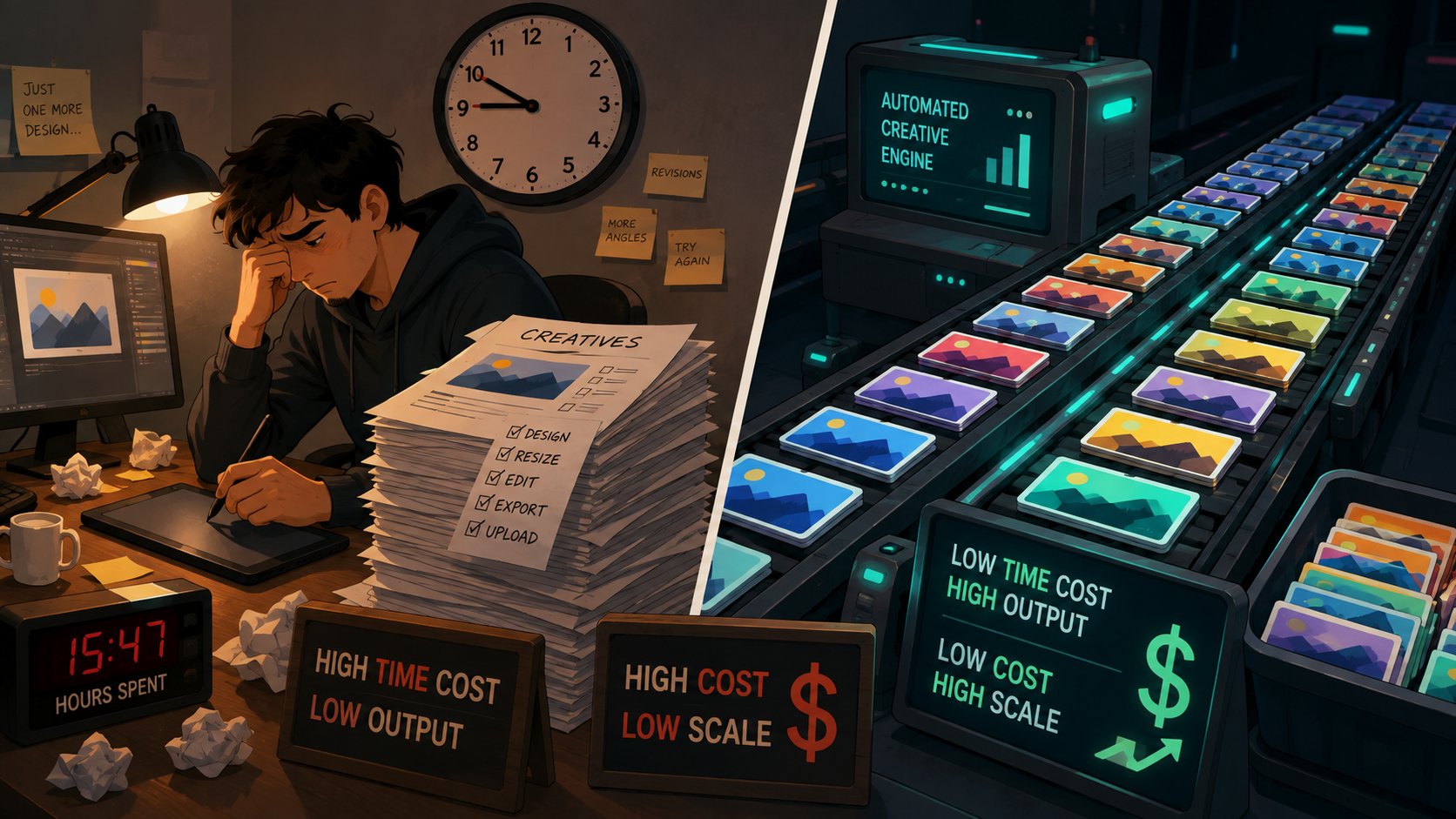
Most operators never run the math on creative production. They know it costs something — a designer's time, a freelancer's invoice, hours inside a design tool — but they treat it as a fixed cost of doing business rather than a variable worth optimizing. Running the numbers changes the conversation.
What a designer actually costs you
A mid-level freelance designer producing RSOC-quality ad creatives will charge somewhere between $25 and $60 per creative, depending on complexity and volume. An in-house junior designer in a mid-cost market runs around $3,000–$4,500 per month all-in.
At $30 per creative and a testing volume of 40 creatives per week, you're spending $1,200 weekly on production. That's $4,800 per month — before the time cost of briefs, revisions, and back-and-forth.
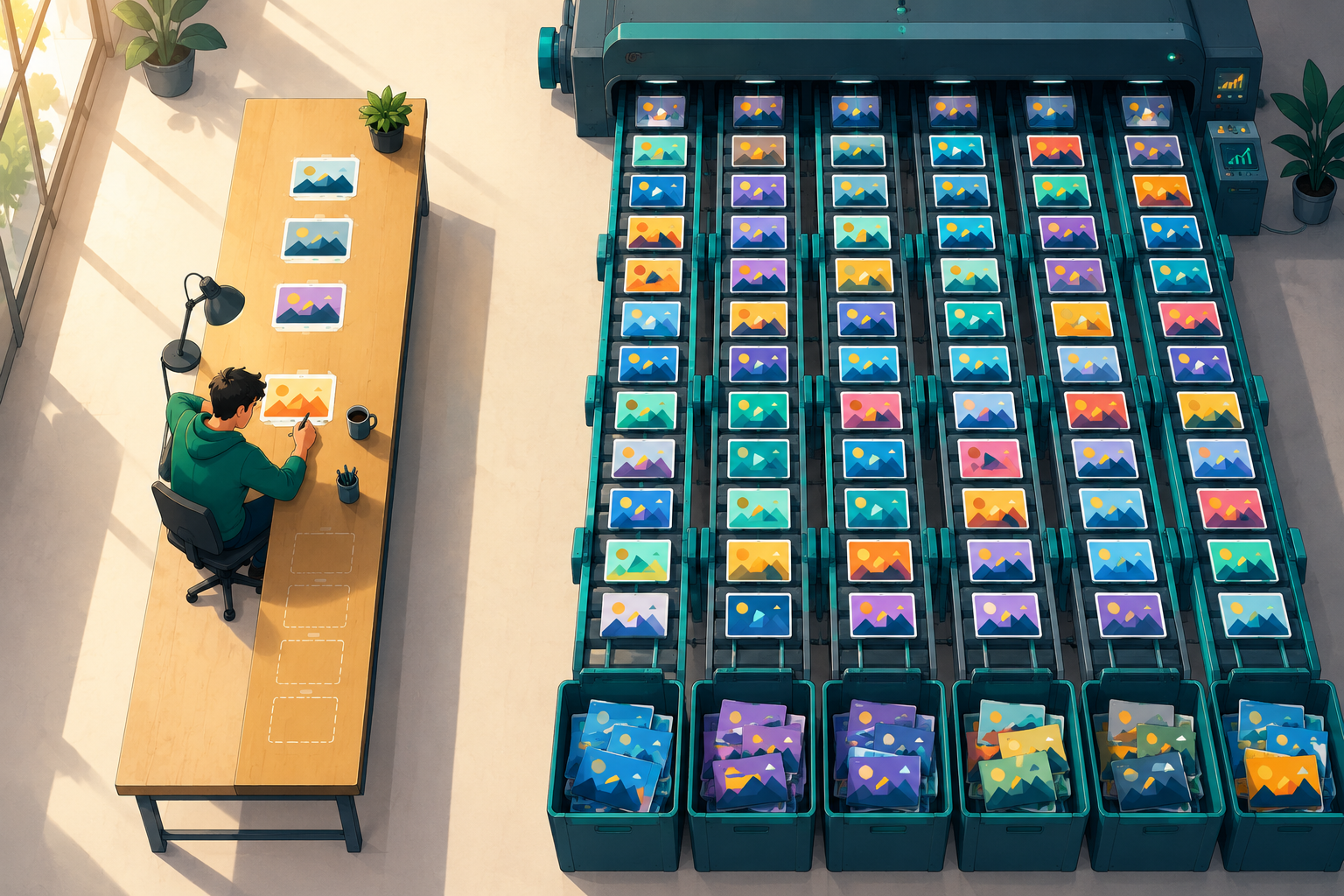
The in-house hire looks cheaper per unit but comes with overhead: onboarding time, management time, and the reality that testing volume in RSOC spikes unpredictably. A staff designer doesn't scale when you find three new keywords worth testing simultaneously.
What you're not counting
The cost most operators underestimate is time-to-live. Every day between "I have a keyword I want to test" and "I have a live ad" is a day you're not collecting data.
In search arbitrage, that delay has a real cost. The window where a keyword converts at margin is finite. A 72-hour creative turnaround compresses that window before you've started. A week-long turnaround can consume the entire profitable period of a short-lived keyword.
This cost doesn't appear on any invoice. It shows up as missed opportunities — which is exactly why most teams don't account for it.
The autopilot model
An automated creative generation tool changes the unit economics entirely. The variable is no longer time — it's volume. You decide how many creatives to generate based on how many keywords you're testing, not on how much designer capacity you have.
At BulkCreative's pricing — $19/month for 100 creatives up to $149/month for 1,000 — the per-creative cost runs between $0.15 and $0.19. Against $30–$60 per creative from a human designer, the economics aren't close.
What you give up is highly customized, brand-specific creative work. What you keep is speed, volume, and the ability to test across languages without multiplying cost by the number of markets.
Who needs a designer anyway
The honest answer: not most search arbitrage operators, most of the time.
RSOC creatives need to be compliant, attention-grabbing, and fast to produce. They're not brand identity work. The operator winning this game has the most data on what angles convert, not the most polished assets.
A designer's judgment matters when you're building something that needs to carry brand equity over time. For an ad that will be killed or scaled within a week based on conversion data, that judgment is largely wasted on the production side.
The math just confirms what the workflow logic already suggests.