
There's a version of search arbitrage where you spend a week refining a creative before launch. Careful copywriting, multiple rounds of feedback, every detail considered. Then it goes live and dies in 48 hours. The market didn't care how considered it was.
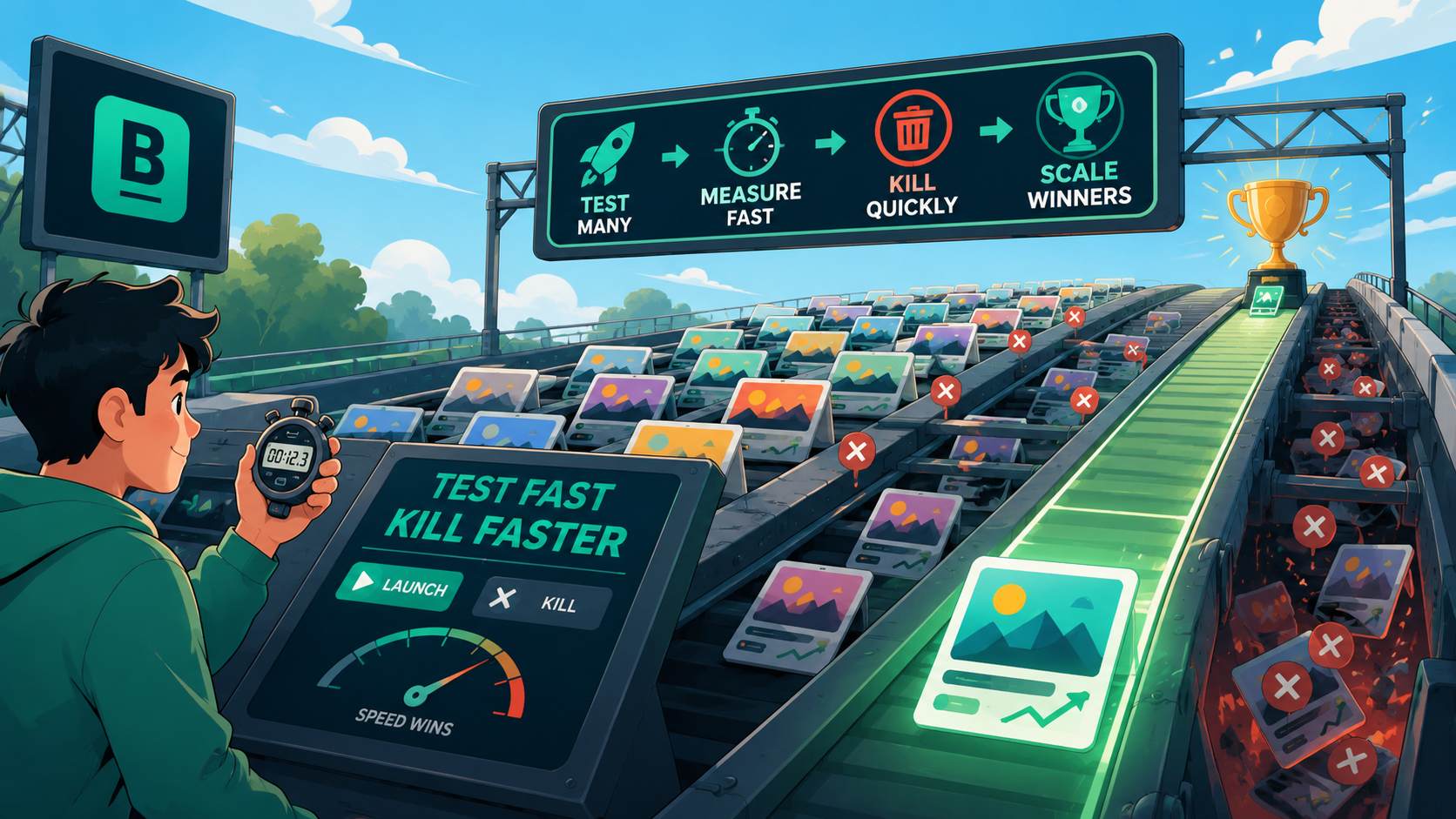
Then there's the version where you launch ten directionally sound creatives, read the data in four days, kill eight, and push budget into the two that are converting. You don't know why they're winning yet, but you know that they are.
That second version learns faster. Every time.
The information problem
Search arbitrage runs on information advantage. The window when a keyword converts profitably is not infinite — CPCs rise, quality scores shift, competition finds the same angle. The operator who figures out what works first gets the most of that window.
You can't figure out what works without running it. No amount of pre-launch analysis replaces what a live audience tells you in 72 hours. So the speed of your testing is directly the speed of your learning, and the speed of your learning is your actual competitive edge.
What "fast" means in practice
Fast doesn't mean careless. It means understanding which decisions need data and which don't.
You don't need data to know that multi-language creatives are worth testing on a keyword with volume outside English-speaking geos. You don't need data to know that multiple formats per keyword will outperform a single format over time. Those are decisions you make in advance.
What you do need data for: which specific angle is converting. Which visual treatment is getting the click. Whether this keyword has any margin at all. Those questions don't get answered at a desk. They get answered in the auction.
Kill faster than you launch
The second half of the principle matters as much as the first. Fast testing without fast killing just means burning budget on signals you've already received.
An ad that runs for two weeks with no signal has cost you money and time you could have spent on the next test. Killing it on day four and reallocating to a new creative isn't giving up — it's freeing the budget to get more reps in.
The operators who are uncomfortable killing things end up running a portfolio of marginal creatives instead of a concentrated position in what actually works.
The creative production constraint
The one bottleneck that breaks the test-fast model is when creative production is slow. If launching a new batch of ad creatives takes three days, your iteration cycle is already broken before the test starts.
Closing that gap — getting from "keyword I want to test" to "live ad" in under an hour — is what makes this model actually executable. That's an infrastructure decision, and most teams get it wrong by treating creative production as a design problem instead of an operations problem.
When it becomes an operations problem, the model works.