Canva is the first place most operators go when they decide to stop outsourcing creative production. It's accessible, inexpensive, and has enough templates to get something decent-looking in an hour. For getting started, it's a reasonable choice. For scaling, it's a trap that doesn't announce itself as one.
What Canva actually does well
To be clear about what we're comparing: Canva's template library is genuinely useful for producing polished, visually consistent assets when you have time to work through it. If you're producing a handful of creatives per week, customizing a Canva template is entirely viable.
The design floor is high. A non-designer can produce something intentional-looking in a way that wasn't really possible before Canva existed. For low-volume testing or for operators building any kind of brand layer into their ads, it's a real tool.
Where it breaks
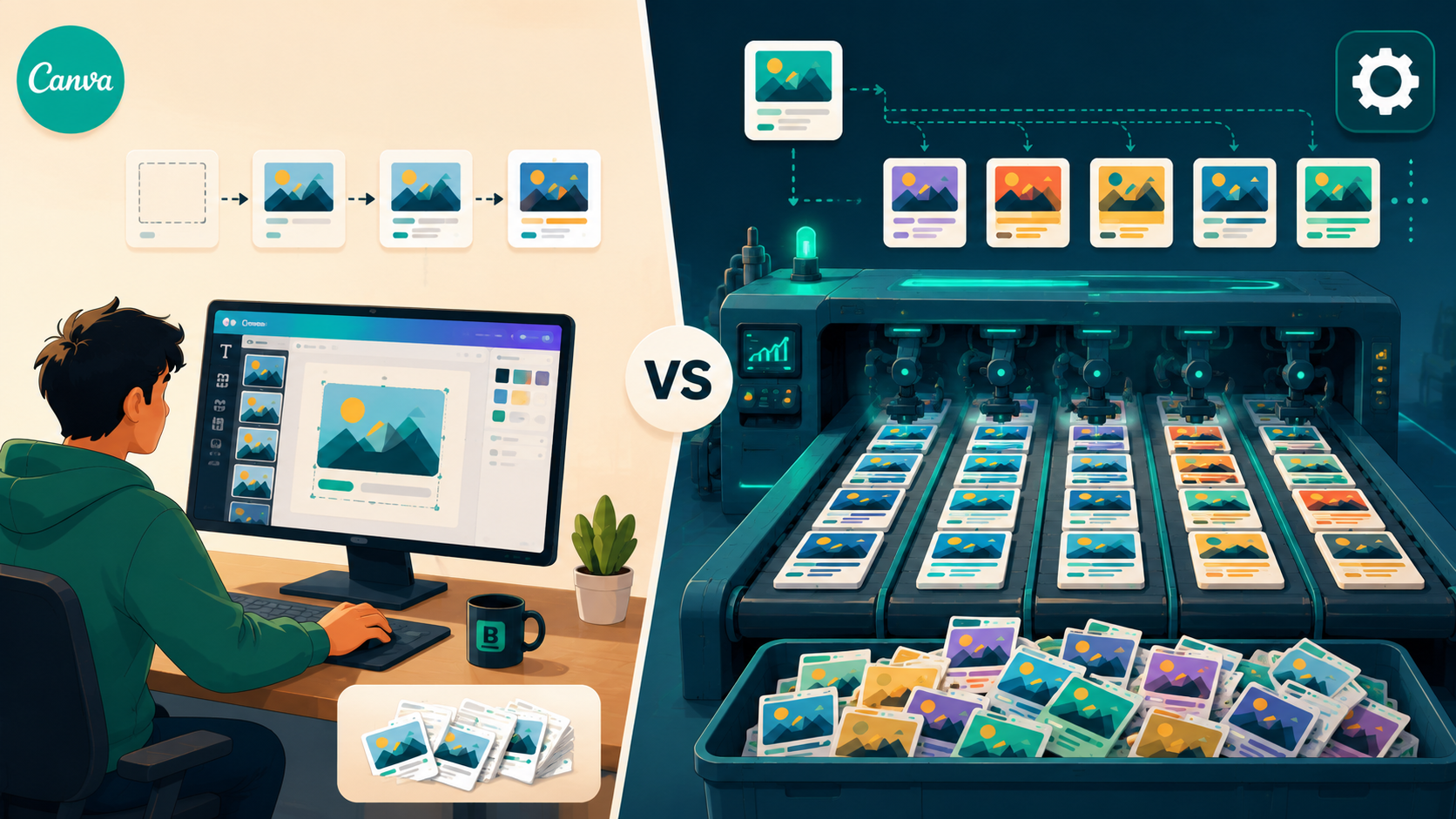
The problem is throughput. Canva is optimized for quality per asset, not volume. Producing one polished creative takes 20–45 minutes once you factor in choosing the right template, adapting it to the keyword, swapping text, exporting in the right format, and repeating for format variations.
At 40 creatives per week, that's 13–30 hours of production time. Canva also means each creative is a manual decision: which template, which text, which layout. Those decisions eat cognitive load that should be going into performance analysis, not design choices.
There's also the keyword-to-creative gap. Going from "I have a new keyword to test" to "I have a live creative" in Canva involves opening the tool, finding a suitable template, filling it in, and exporting. Multiply that friction by the number of keywords worth testing in any given week and the bottleneck becomes obvious.
The language problem
If you're running traffic in more than one language, Canva requires you to manually recreate each creative in each language. That's not a minor inconvenience — it effectively multiplies your production time by your number of target languages, which most operators simply don't do. They stay English-only by default, not by design.
What the automated alternative looks like
An automated creative generation tool handles the keyword-to-creative conversion differently: you input the keyword, select language and format, and receive multiple export-ready images. No template selection, no text customization, no format juggling.
That's not a faster version of the Canva workflow. It's a different workflow that removes the manual steps entirely. At BulkCreative's pricing, the cost per creative is also a fraction of what the hourly time a Canva workflow implies.
What you give up is fine-grained visual control. The assets are built on proven RSOC-ready formats, not infinitely customizable templates. For RSOC-compliant media buying where speed matters more than bespoke visual identity, that's usually the right trade.
The honest take
Canva makes sense for operators doing low volume, for teams that want brand consistency, or when the creative needs to carry something beyond a search arbitrage click. Those are real use cases.
For pure RSOC media buying at testing volume — where the job is to produce enough variation to find what converts, fast — the Canva workflow will eventually cap your learning rate. Not because the tool is bad, but because it was never designed for what you're asking it to do.